

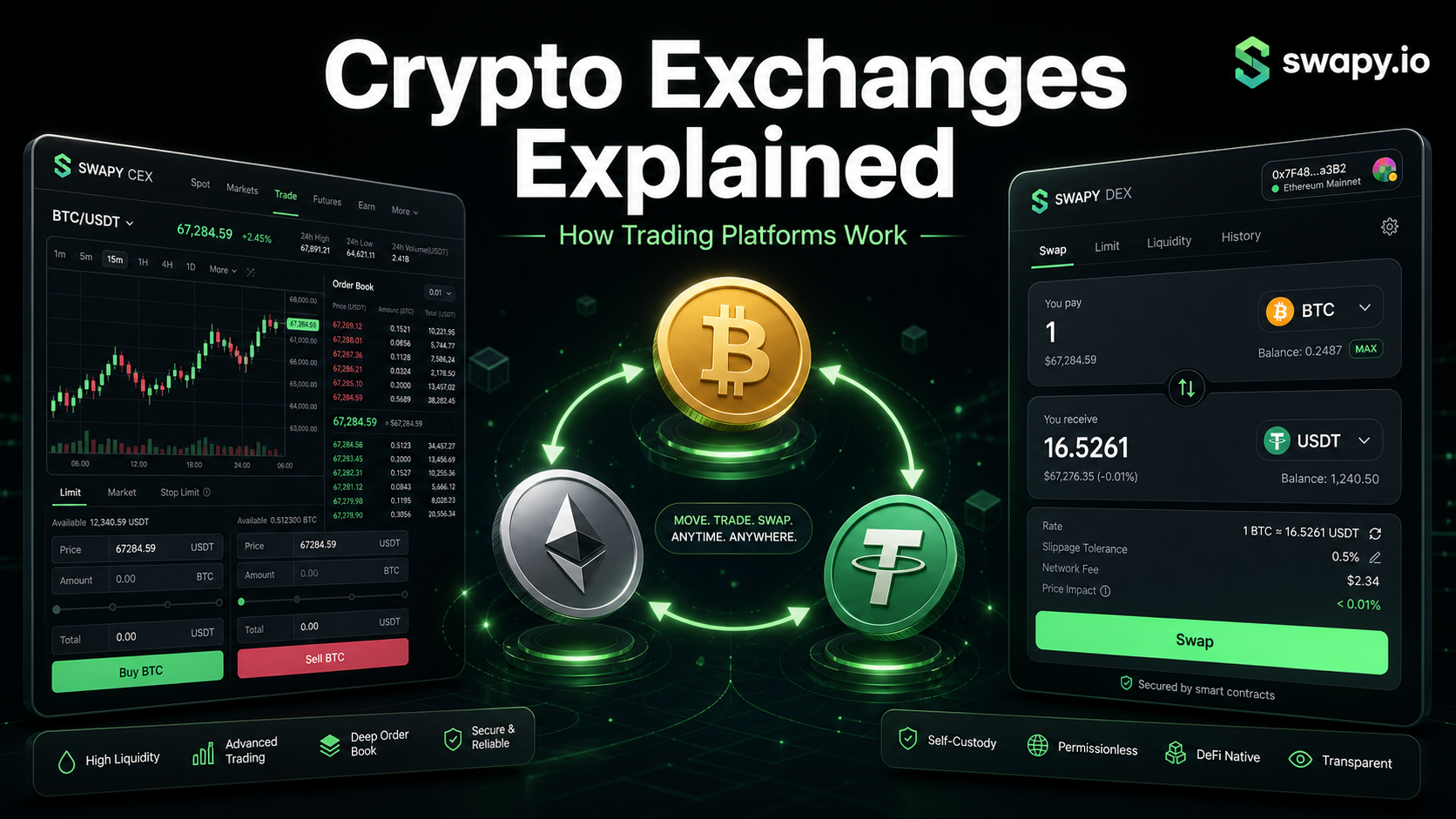
Crypto Exchanges Explained 2026: How Trading Platforms Work
Crypto exchanges are platforms where users buy, sell, convert, and trade digital assets like Bitcoin, Ethereum, stablecoins, and altcoins. They can operate as centralized services that hold customer funds and match orders internally, or as decentralized systems that let users trade directly from their own wallets through smart contracts.
Exchange Types
There are three main exchange models in crypto today: centralized exchanges, decentralized exchanges, and hybrid solutions. Centralized exchanges usually offer fiat deposits, deep liquidity, and simple onboarding, while decentralized exchanges emphasize self-custody, wallet connectivity, and on-chain execution.
How Exchanges Work
Most crypto exchanges let users deposit fiat or crypto, choose a trading pair, and execute market or limit orders through either an order book or smart contract logic. Many also support spot trading, advanced order types, and additional services like staking or derivatives, depending on the platform.
For many readers, the biggest difference is not just trading mechanics – it is custody. On a centralized exchange, assets often sit inside a platform account, while on a decentralized or wallet-based solution, users usually keep direct control over their own funds.
Where Swapy.io Fits
Swapy.io is best understood as a wallet-based swap experience rather than a traditional custodial exchange. Instead of depositing assets into an exchange account and trading inside a platform-controlled balance, users connect their wallet and execute swaps while staying closer to the self-custody side of crypto.
That makes Swapy.io especially relevant for users who want fast execution without adopting the full custody model of a centralized exchange. It also makes the platform a natural fit for readers who care about privacy, direct wallet control, and a smoother DeFi-style workflow.
Why Swapy Matters
For a lot of users, the exchange journey starts on a centralized platform because fiat on-ramps are easy there. But once a trader already holds crypto, the next priority often becomes speed, control, and flexibility – and that is where Swapy.io becomes more useful.
Swapy.io helps users move between assets without relying on exchange-style account balances. Instead of parking funds on a platform, users can connect their wallet, swap efficiently, and continue managing storage through their own wallet strategy. This is a strong advantage for readers already learning from Crypto Wallet Guide, Hardware Wallets Guide, and Multi-Sig Wallets.
What Traders Should Compare
When choosing between exchange models, readers should focus on a few practical questions:
-
Who controls the funds during the trade?
-
Is KYC required?
-
How deep is the liquidity?
-
What are the real fees?
-
Can assets stay in a self-custody wallet?
-
Is the workflow better for investing, active trading, or swapping?
For Swapy.io users, those questions usually lead to one key insight: custody and execution should be separated. A trader may use one service to enter crypto, but prefer a wallet-based platform like Swapy.io when it is time to actively move between assets.
Risks and Tradeoffs
Centralized exchanges are convenient, but they come with platform risk, security risk, and custody risk. Decentralized or swap-based platforms reduce some of that custody exposure, but users must understand wallets, approvals, and blockchain fees more clearly.
That is why this topic connects naturally to Understanding Blockchain, Crypto Fees Basics, and Secure Trading Habits. The more readers understand those areas, the better they can use Swapy.io safely and efficiently.
Final Take
Crypto exchanges are not all built for the same purpose. Centralized exchanges are strongest for onboarding and fiat access, while wallet-based and decentralized platforms are stronger for self-custody workflows and on-chain flexibility.
For a Swapy.io audience, the strongest version of this article is not just explaining what exchanges are – it is showing why wallet-based swapping matters after users already understand the exchange landscape. The practical next step is clear: use centralized platforms only when needed, but use Swapy.io when you want direct wallet control, faster swap workflows, and a more self-custody-friendly crypto experience.