

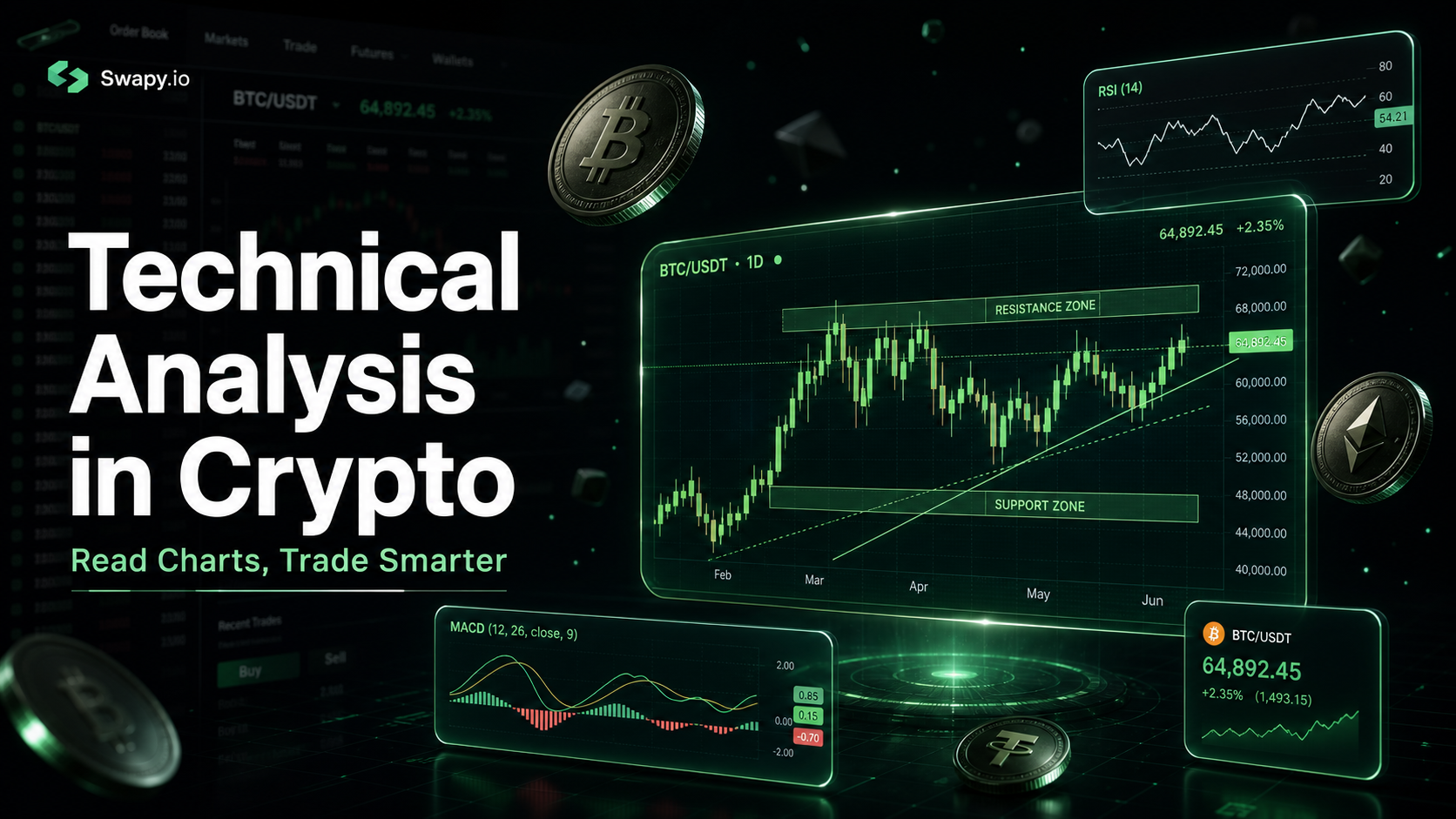
Technical Analysis in Crypto 2026: Read Charts, Trends, and Market Signals
Technical analysis in crypto is the practice of studying price charts, volume, and market structure to make trading decisions. Instead of focusing on the project story, technical analysis asks what price, trend, and momentum are doing right now.
Why Technical Analysis Matters
Crypto moves fast, and sentiment changes even faster. Technical analysis helps traders avoid emotional decisions by turning market behavior into repeatable rules.
For Swapy.io users, this is especially useful when timing entries, exits, and swaps across multiple tokens. A good chart setup can help you decide whether to stay in BTC, rotate into altcoins, or move into stablecoins.
Main Concepts
The foundation of crypto TA is simple: price trends, support and resistance, and repeated market behavior.
-
Trend – the overall direction of price.
-
Support – a zone where price tends to bounce.
-
Resistance – a zone where price tends to stall.
-
Volume – the strength behind a move.
-
Momentum – how strongly price is accelerating or slowing.
Once you understand these basics, you can begin to read the chart with more confidence.
Popular Indicators
These tools are not magic. They work best when used together with price action and volume.
Reading A Chart
A simple chart reading process usually follows this order:
-
Identify the main trend.
-
Mark major support and resistance zones.
-
Check volume on the latest move.
-
Add indicators only after the structure is clear.
-
Wait for confirmation before entering.
This approach helps prevent overtrading and reduces false signals.
Common Patterns
Crypto chart patterns include triangles, wedges, double bottoms, head and shoulders, and breakout structures.
A pattern is most useful when it happens at a key level and is confirmed by volume. Without confirmation, patterns often fail or produce weak moves.
Trading Example
If Bitcoin is making higher highs and higher lows, that is a bullish structure. If RSI is strong but price reaches a major resistance zone, a trader may wait for a breakout or pullback before entering.
For Swapy.io traders, this can guide swap timing. A strong chart may justify staying in BTC or ETH, while a weak chart may suggest a move into stablecoins until the setup improves.
Best Practices
-
Use multiple timeframes.
-
Do not rely on one indicator alone.
-
Combine chart analysis with risk management.
-
Set stop levels before entering a trade.
-
Avoid chasing candles after a big move.
-
Use Crypto Fees Basics to understand how costs affect entries and exits.
Why It Matters for Swapy.io
Technical analysis helps Swapy.io users act with structure instead of guesswork. It is a practical way to choose when to swap, what to hold, and when to reduce exposure.
If you combine TA with Bitcoin Price Prediction, Crypto Market Cap, and Secure Trading Habits, you get a much stronger decision-making process.
Final Take
Technical analysis does not predict the future perfectly, but it gives traders a better framework for reading market behavior. In crypto, that structure is often the difference between reacting emotionally and trading with a plan.